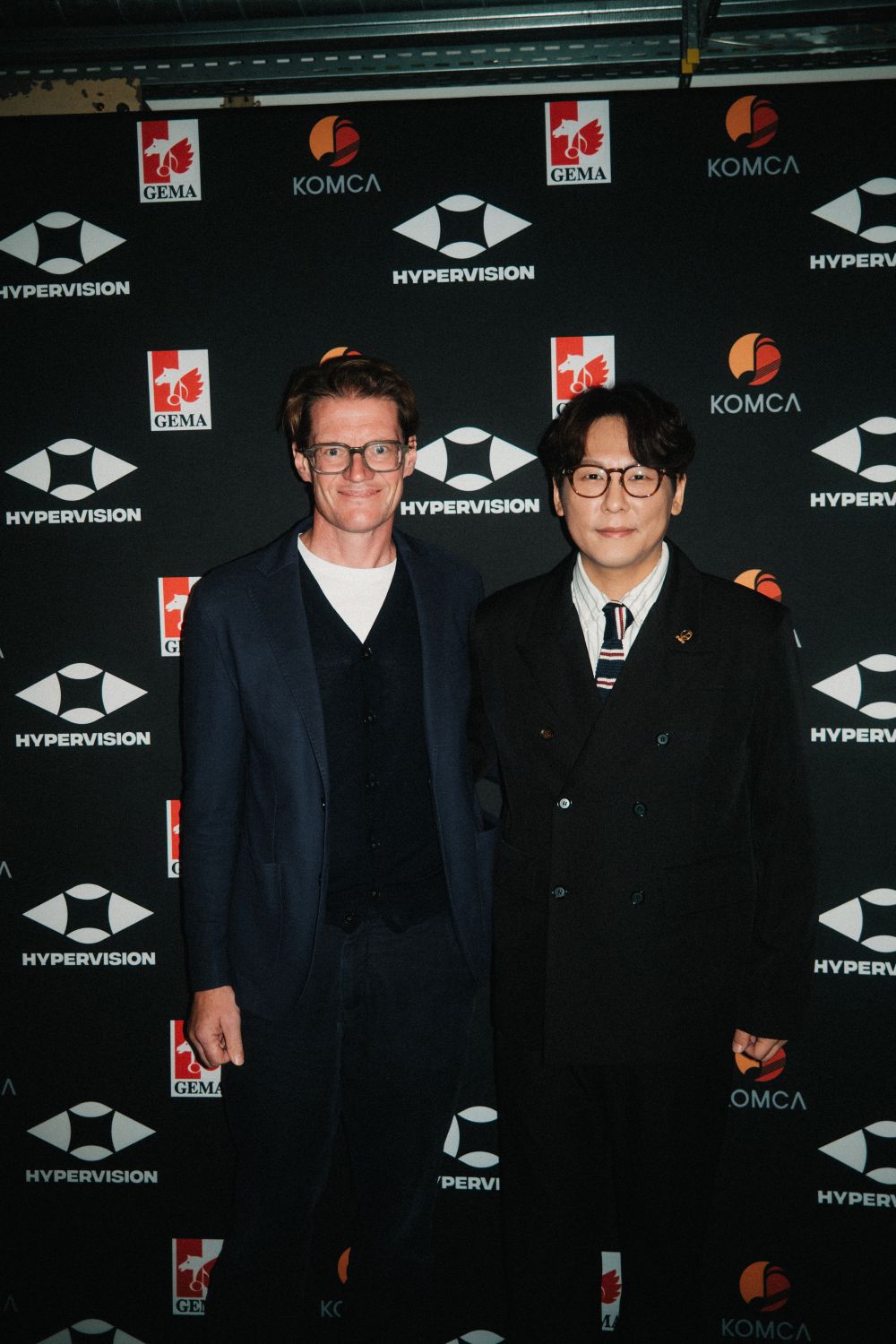
In tandem with Korean collecting society KOMCA (Korea Music Copyright Association) and music publisher Hypervision, GEMA recently organised a Songwriting Camp in Berlin's Kung-Fu-Studios. Between November 9 and 11, 2026, an international group of 22 composers, lyricists and producers from Germany and South Korea teamed up to create new songs to pitch for K-pop acts. The aim of the workshop was to build creative bridges between two of the world’s most significant music markets in the trending K-pop genre, and by doing so, open up new opportunities for music creators in both countries.
“K-pop has long since become much more than just a pop culture phenomenon – it’s a business driver with global impact. When seven of the world’s ten best-selling albums come from Korea, that’s adding the kind of value musicians in Germany could – and should – be able to benefit from. But for this to happen, you need two things: a creative meeting of minds plus effective rights management across national and international borders. In KOMCA, we’ve found a partner capable of both. And by organising our first joint Songwriting Camp in Berlin, we’re giving a major boost to German-Korean collaboration. Our aim is to strengthen the long-term relationships between our members while simultaneously enhancing the cooperation between our two collecting societies – so we can turn joint songwriting projects into shared successes,” explains Dr Tobias Holzmüller, CEO of GEMA.
“As a Korean rocker who grew up practising songs by the Scorpions and listening to NENA’s “99 Red Balloons”, it’s especially meaningful for me to serve as Chairman of KOMCA and work alongside GEMA – a partner we trust implicitly. While German music was the soundtrack to my youth, I’m hoping that the music made here by Korean and German songwriters will produce worldwide hits and eventually become the soundtrack inspiring other young people around the world. I’d like to say to all songwriters: make all the music you want, as freely as you want. Wherever your music ends up, GEMA and KOMCA will work to ensure that your rights are protected and you’re fairly paid for your creations,” emphasises KOMCA President Lee Si-ha.
“We’re delighted to be the first music publisher to join with GEMA and KOMCA in organising a K-pop camp in Germany, where we can bring German talent together with international songwriters from Sweden, the UK, Norway and Korea, and welcome them all to Berlin. As our partners, GEMA and KOMCA are very happy to support this Songwriting Camp both financially and creatively, joining us in actively encouraging musicians to create lots of great songs,” adds Max von Thadden, cofounder of Hypervision.
South Korea is one of the world’s largest music markets. According to the latest Global Music Report published by the International Federation of the Phonographic Industry (IFPI) in 2026, the country ranks seventh in the world, with Germany just a couple of places ahead in fifth position. Although South Korea’s domestic market is relatively small, the country has built a music industry that is enjoying extraordinary success on an international scale. This success reflects the dynamism of the Asian music market as a whole – in 2025, the region generated a 10.9 percent increase in revenues, making it one of the fastest-growing regions in the music world.
K-pop enjoys a record-breaking year
In 2025, seven of the ten best-selling albums in the world were by K-pop acts, led by Stray Kids with “Karma” (3.49 million certified units). Stray Kids also ranked second among the world’s most successful artists – just behind Taylor Swift. Globally, 61 billion K-pop songs were streamed outside Korea on Spotify alone. In Germany, K-pop entered the mainstream music market a while ago. In 2025, the track “Golden” from Netflix film “KPop Demon Hunters” was the first K-pop song to reach number one in Germany’s official singles charts. The track came in at number five in GfK Entertainment’s annual charts, while another K-pop hit took second place – “APT.” by Rosé (from K-pop girl group Blackpink) and Bruno Mars. With “Karma”, Stray Kids also topped Germany’s album charts for the first time.
International teams as a model for success
International songwriting camps bring together talented individuals from multiple countries, fostering creative synergies and helping to generate new musical works. In the world of K-pop production in particular, songs are often developed by global teams blending influences from different countries, cultures and music markets. Many K-pop hits draw on sounds characteristic of European – especially German – pop and dance-pop music.
“K-pop’s international success shows just how powerful music can be when it transcends borders and cultural boundaries. By organising this camp, we wanted to strengthen the collaboration between our members and Korean songwriters and producers, building new relationships and encouraging the sharing of creative ideas between two of the world’s most exciting music markets. When you bring together Berlin’s experimental mindset with the Korean flair for hits, you get music with international appeal. And who knows – very soon, people all over the world may be listening to the resulting songs,” says Lisa-Marie Wetter, Head of Key Accounts at GEMA. The Songwriting Camp explicitly targeted the K-pop genre, aiming to produce demo tracks that could be submitted to song pitches for major K-pop acts.
Protecting rights, unlocking markets
As collecting societies, GEMA and KOMCA ensure that creative talents receive fair remuneration for their work, even at international level. The camp has expanded this collaboration to include creative exchanges between peers, supporting talented individuals and creating space for new musical ideas. It is just one of GEMA’s various programmes for young and emerging artists, which regularly feature similar events in Berlin. As the city with the highest number of composers and lyricists in Germany, Berlin is the ideal setting for such events. This is how GEMA supports members’ artistic development and provides them with opportunities for international collaboration and visibility.
Hypervision is an independent music publisher and management agency based in Berlin and operating internationally. Focusing in particular on exceptional creative services and meticulous copyright administration, Hypervision currently represents a roster of nearly 20 artists across a wide range of genres.
KOMCA (Korea Music Copyright Association) is the collecting society for music creators and publishers in South Korea. Its main remit is to grant licences for its members’ musical works and to collect and distribute the resulting royalties.
In Germany, GEMA represents the copyright interests of more than 100,000 members (composers, lyricists and music publishers), as well as over two million owners of intellectual property rights worldwide. GEMA is one of the world’s largest collecting societies for creators of musical works.
Media contacts:
Christina Zander, Communications Manager
E kommunikation@gema.de, T +49 (0) 89 48003 421
KOMCA: Saw Ye Hong, Senior Assistant Manager
E sawyehong@komca.or.kr
Hypervision: Max von Thadden
E max@hypervision.club
Downloads:
Here you will find pictures from the songwriting camp.